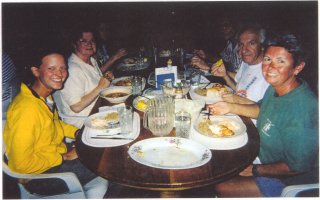
 Seaweed,
the magnificent (by Judy)
Seaweed,
the magnificent (by Judy)
March 10 - 17, 1999
Introduction:
Elderhostel is an organization which provides the retired professionals opportunities for learning through travel. I went to France in 1998 and cycled through the Loire Valley. The organization has also a service program in which one travels and does volunteer work for nonprofit institutions. The concept is to learn though service to others. Usually no previous experience is a prerequisite. Also, programs are intended to be economical, i.e. participants stay at modest hotels, but meals are not modest. There are always lectures to attend as a part of any program.
This year Beverly and I chose to go travel to Belize on a service program volunteering for the Oceanic Society Expeditions (OSE) in San Francisco. We will collect observational data on bottle nose dolphins and manatees off the shores of Belize. There are numerous cayes (small reef islands, pronounced keys, but kays is another way although unused) and atolls (reef surrounding a lagoon). There are three graduate students who will instruct us on the type of data to collect for their theses. Although there is quite a bit of research done on dolphins, not enough has been done in warm water, and Belize is a good setting for that.
Preparations:
The instructional material we received from the sponsor, OSE, said that we should have tetanus, hepatitis-A shots, and take anti-Malaria medicine. We went to the Health Department in Huntsville on February 18, 99 for shots. Beverly’s arms got sore; mine did not. The malaria medicine was supposed to be taken one pill a week starting the week before we leave and continue four weeks after returning. My doctor gave me 500 mg while Beverly got 250 from hers. When I took the first one, I did not feel good the next day. One of the side effect of the medicine is confusion and psychosis, but neither one experienced such problems to our knowledge.
I have bought a book, one of the recommended list supplied by OSE, about dolphins written by Ellis. There is a long chapter on bottle nose which I read. They are social, playful , intelligent animals, but can be unfriendly at times of their choice. The instructions we received from OSE indicate that we as observers are not to touch or feed the animals. We will be told when to get in the water and in pairs only to observe and record data.
This evening, March 4, 99 Beverly and I went to a diving store in Huntsville and bought snorkeling masks and fins. The owner took us to a swimming pool in the north part of town and gave us a lesson. It was very useful because we forgot how to use the equipment after we did it once in Hawaii years ago. I was nervous and cold in the heated pool. I was even shivering. The first few times I swam I swallowed buckets of chlorinated water. When I breathe through the snorkel, I am always afraid that I will take water into my lungs. Although I swallowed water, non went into the lungs. After a few tries both of us did well, and we even went along the length of the pool at one time. It was not lots of fun but it was a necessity since we are set to go. We practiced one more time before we flew to Belize the following week.
Travel:
We planned to take two days each way for travel to Belize and back because
of airline connections. On Tuesday March 9 we drove to Atlanta and stayed
there overnight. Next morning we flew to Miami and made the international
connection on Taca to Belize City; a trip of less than two hours. Taca
is a group of Central American air lines. We were met by Caroline (the
daughter of the owner of Spanish Bay resort where we were scheduled to
stay) who drove us to Feista Hotel to wait for other members of our group.
Per the given instructions we walked to the awaiting boat which took us
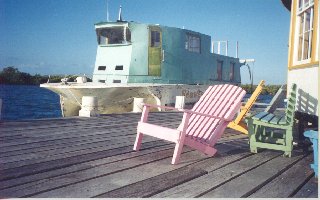
to the resort in an hour ride. The boat of the perfect name Seaweed is
a spacious trihull with a cabin bridge and fairly comfortable seats. It
is designed by what looks like uncoordinated committee. Its parts seem
to be salvaged from several old boats, and put together by non professionals.
The engine is of course from yet another and pushes Seaweed at 15 knots.
The driver is Gilroy, who is a good humored fellow and matches the boat.
The color is white with many rusted spots, and the bridge has taken the
sea color, sort of emerald We arrived at the resort late afternoon
and were met by Elda, the manager, who is Mayan ancestry, and assisted
by her daughter, niece and relatives. She is a pleasant lady who is knowledgeable
of the place since she was there at the creation. Elda assigned each two
of us to a cabana and instructed us on the protocol of the resort.
Seaweed,
the magnificent (by Judy)
Housing
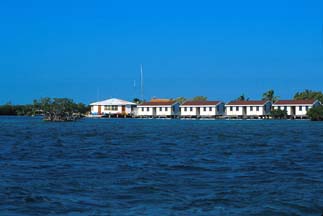
Cabanas were built in one row on concrete stilts as was the central
building. Each cabana has two beds, a desk and a bathroom with airplane
size sink. Water is filtered sea water and therefore a precious commodity.
She asked us to limit our showers to once a day. Electricity is generated
by an old engine and came on two hours in the morning, and noon, and four
hours in the evening. There is no air-conditioning but each cabana had
five windows and two doors which provided enough air circulation. There
is no television, telephone or internet and of course no newspapers. It
was real isolation.
 Cabanas
on stilts (by Bob)
Cabanas
on stilts (by Bob)
Staff Researchers (Graduate Students):
Heidi Peterson (University of San Francisco)
San Francisco, CA
Heidi is the dolphin lady
Caryn Sullivan (University Texas A&M)
Fredericksburg, VA
Caryn is the manatee lady.
Kate Schafer (UC Berkeley)
Pleasanton CA
Kate is the coral reef and stomatopods researcher. She was in charge
of another group simultaneously with ours.
Participants: (Dolphins and Manatees program)
David and Rachel Lehmberg
Oceanside, CA
David did not shave but whiskers stayed the same length. He did not
believe manatees exist. Davis and Rachel were divers.
Judy Hoyt
Idyllwild, CA
Judy is an artist and believes Nike Shoes Co. is rotten because it
exploits workers in foreign countries.
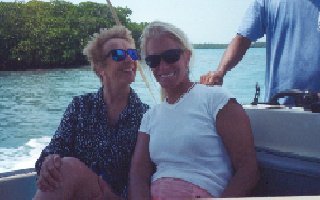 Lin
and Judy
Lin
and Judy
Helena Garan
Binghamton, NY
Helena was the spirit of the group. Every group should have a Helena.
She enjoyed herself very much; laugh a lot and told many stories and riddles.
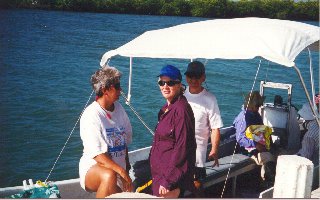 Helena
and Caryn
Helena
and Caryn
Art and Lenore Niedzielski
Newtown, CT
A pleasant couple, with a hard to pronounce name. Art helped me when
I had a problem with snorkeling.
Lin Carlson
Idyllwild, CA
Lin showed us the card game 99 which we played every evening and had
tons of fun.
Bob and Margaret
Arvada, CO
Bob is a diver and a professional nature photographer with equipment
to match. His pictures appear on calendars. Margaret told us many good
jokes. You may visit his web page- click 
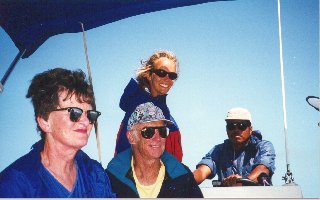 Bob,
Margarete and Heidi seeking dolphins
Bob,
Margarete and Heidi seeking dolphins
Marge Dosik
Vestal, NY
Marge is a friend of Helena. She participates in an Elderhostel in
Binghamton, N.Y. She said that some hostelers back home should be called
Hostel Elders. She liked her assigned duties on the boat; she measured
the water depth and clarity using what we called suckie disk.
Thomas A. Humphrey; aka: Sir Thomas ;-)
Durham, NC
Thomas has a good sense of humor and a friend of Barbara.
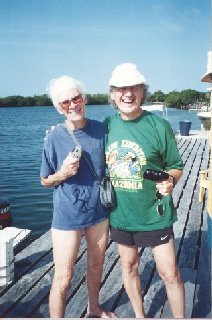 Barbara
and Thomas (by Judy)
Barbara
and Thomas (by Judy)
Barbara Birkhead
Durham, NC
At 77, Barbara was the inspiration of the group and specially to me.
She is very agile, has great spirit, and is pleasant to be around.
Other Participants in a different program (Coral Reef):
Sandy Duncan
Centralia, WA
Pleasant lady and good card player
Andy Fondrik
Chesterland. OH
Our next door cabana neighbor and a good bird man.
Jean Love
Norfolk, VA
Good card player and won the money several times.
Ann (Livesay) Sutton
Medford, OR
A mystery author, written about 20 novels; uses forests and jungles
for the settings.
Bev Wagner
Renton,WA
A nice and gentle lady who played cards.
Betty Walker
Massies Mill, VA
Fellow participant in our daily morning walks.
Food:
Elda provided Belizean cuisine everyday, some of which was American. Quantities were just sufficient and hardly was there any leftover. Breakfast and lunch included juice and fruits of native variety which I liked; one of which is fermented pineapple juice. Others were banana juice, and papaya juice The fruits included papaya, mommay, sappadilly, bananas and melons. She served eggs fried with tomatoes or just poached. The eggs are small, maybe because their chickens are small. I asked for omelets made of egg whites only and she accommodated me as she did for others who were on special diets. One breakfast included bean soup and tortillas. Lunch is always soup with fish and juice. The soup is invariably good tasting and many times it has cilantro which I do not like, but I learned to eat it because we had it almost daily. We had tortillas filled with ground fish as was the fish pie for a lunch. The fish did not look appetizing, like ground up stomatodpods; which is a fish one of the two groups on which it was collecting data. Dinner was again fish, vegetable and fruits. It is the only daily meal which included a desert. We also had plantain, which looks like large bananas. Elda told me how to cook it; just boil it. We had beef once in the whole week, which was a meat loaf. The food tends to be close to Mexican flavor, but milder except for the mild hot sauce as optional condiment, which I learned to like. It is made of hot habanero pepper in carrot juice.The food was generally well prepared, healthy, tasty, not greasy and just adequate quantities. One evening we had baked snapper prepared in tomato sauce and it tasted very delicious.
Orientation:
In the first day we met the researchers in the Research Center building which looks like a barracks. The researchers were graduate students from different universities and were supported in part by the OSE. They were Caryn, Heidi and Kate. Heidi was a Master student from University of San Francisco, studying the dolphins; she lived for a while in Ramallah teaching English and learned Arabic. Caryn , in charge, a Ph.D. student from Texas A&M, with specialty in manatees. Kate is a Ph.D. student from UC Berkeley, and was interested in stomatopoda and coral as indicators of the quality of life of the reef. It was interesting to note that all three talked with the same accent which has a trailing intonation. Collage girls are prone to speak this way more than boys. Caryn has also Virginia infliction specially when she says a word like "about".
The first morning was spent in orientation about the research these students were conducting. They wanted to study the behavior of the dolphins and manatees. In particular their social attributes and the environment in which they live. The animals are very sociable and imitative. We are not to touch or feed them if we happened to be close to them.
Sargenat Caye(post card)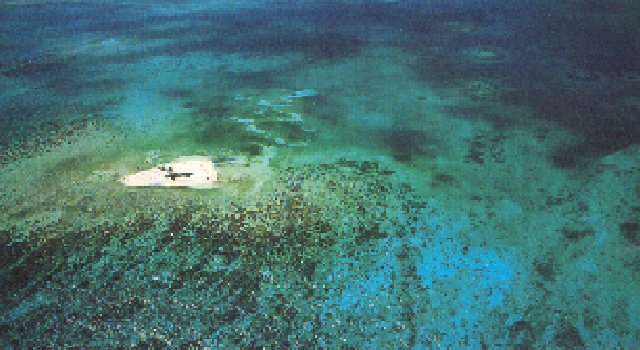
After lunch, we were checked out for snorkeling by the dock. Then we were taken by boats to Sergeant Caye where the coral reef was very good and colorful. We got in the water to snorkel and it was very nice even though I was nervous about it. After a while I noticed that I was far out in the sea away from the boat. I turned around and began to paddle back but I was not moving. I got in a current which was taking me away from the boat. I struggled but I panicked so I called for help. Art and Beverly came and pulled me, then Heidi and the boat driver came with the rescue floating ring. I hung onto it for a while then I let it loose and paddled on my own to the boat. I rested and tried again but I was not comfortable.
Sightings:
Next morning our real work started. We went alternatively with Heidi and Caryn to look for dolphins and manatees, respectively. We went by boat to the Drowned cayes and the boat trolled along a caye and between cayes which are called bogues (pronounced boags). A bogue is a narrow waterway between two mangroves. The name "Drowned" is appropriate because the mangrove trees live in the water as if they are drowning.
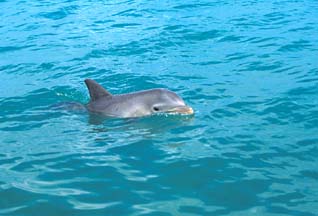 Dolphin
( by Bob )
Dolphin
( by Bob )
We saw dolphins including a baby one who came close to the boat. At sightings we identified the animal and Heidi took pictures of them to study them. Dolphins move in an erratic and unpredictable way and very swiftly. It is hard therefore to take pictures of them. One dolphin, Stimpy, is a familiar one who often comes to Spanish Bay in the mornings. His dorsal fin is chopped off at the top. The boat either trolls or stops so we observe. Most of the time we just saw the dorsal fin bobbing up and down. When the dolphin shows its tail fin it means it is going to take a deep dive. After a sighting, we took environmental measurements, which include the position using a GPS reading, water temperature, wind speed and direction, water salinity, water depth and clarity, all were recorded. Also recorded the sky condition, sea chop, and swell.
Once we were observing a dolphin bobbing up and down when by accident it collided with a manatee. The manatee struck back at the dolphin, and there was a big splash of water. It was a sight to see the two large animals fight.
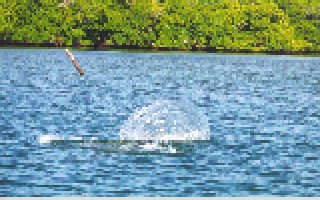 Encounter,
manatee & dolphin (by Marge)
Encounter,
manatee & dolphin (by Marge)
Judy who is an artist and talented created identifiers for us. She took the salinity measurement with me dropping sea water on the salinity meter. She called herself salinity affinity. She called me popper dropper, since I would drop the water with a dropper on her device. Marge loved taking the depth measurement and clarity with a Secci disk, which we called suckie disk. It is and igneous device made up of a circular disk divided into four quadrants painted alternatively black and white. To determine the water clarity, she would lower the disk until she is no longer able to distinguish the black from the white. For the depth, Marge dropped the disk until it hit the bottom. She would then count the foot markings on the line. Judy called her Depth Charge Marge. The wind velocity and direction were determined by Lin using a device with two small holes which are directed to the wind. A small ball would go up a tube a distance proportional to the wind velocity. That was windy Lindy. The water temperature was measured by Helena who was Hells Cells (for Celsius) with a thermometer mounted inside a short PVC pipe which she dipped in the water for exactly two minutes. Bob had no job so he was No Job Bob. Beverly and Margaret were the recorders on laminated forms mounted on clipboards and a grease pencil. When we get the order to take measurements, everyone would immediately reach for his or her instrument.
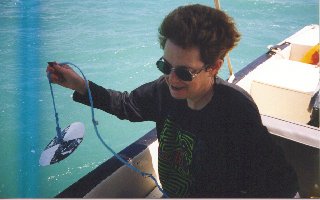 Marge
measuring depth and calrity Marge
measuring depth and calrity |
Lin measuring wind;
Judy, Salinty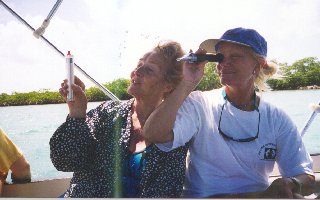 |
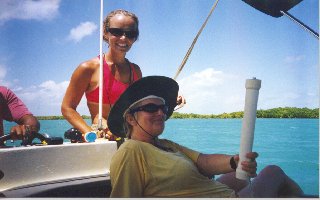
Temperture by Helena. Heidi guiding |
When we go with Caryn, we looked for manatees which stayed submerged under water except when they stick their nose out for a breath. Dolphins breath voluntarily unlike humans for example. It is not known if the manatees breath the same way. They are docile animals and have no predators except man who hunted them for meat for a long time. At sightings, we again take environmental measurements the same we did for dolphins. However Caryn divided us to two teams each taking the same data. Moreover, she also wanted to take the temperature and salinity at both the surface and the bottom of the sea water. She dove to get the sample of bottom water for the salinity
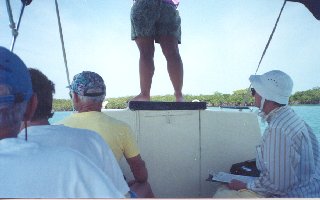 .Looking
for dolphins (all forward looking)
.Looking
for dolphins (all forward looking)
One day, which was not our turn with Caryn, she sighted a manatee close by. Two groups of two individuals each snorkeled to within 20 feet and observed the animal. My group did not, get to enter the water unfortunately. While dolphins eat fish, manatees eat only grass off the bottom of the sea which is very plentiful. It is for this reason manatees thrive in Belize’s water.
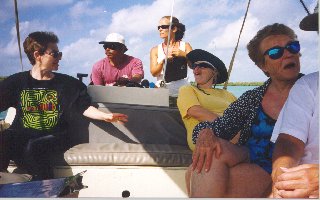 Still
looking for dolphins- not behind
Still
looking for dolphins- not behind
Heidi and Caryn took us just about every day snorkeling which was good thing to do. After a few times, I felt comfortable with it, such that I took pictures with a disposable underwater camera. We also had fruit breaks , usually oranges and sometimes bananas. Caryn also told us that while on boat excursion, if one likes to go to the bathroom, one would say "I want to cool off." Excursions were twice daily before and after lunch.
Underwater coral 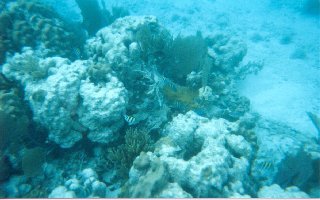
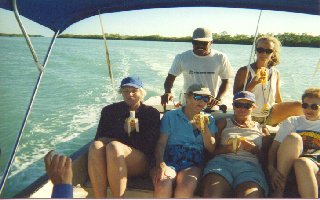 Bananas
are bad luck on fishing boats
Bananas
are bad luck on fishing boats
Lectures:
A part of Elderhostel program is daily lectures at 6:00 PM. Every evening and before dinner, we would have a lecture given by one of the researchers. First we talked about experiences of the day. Then we heard a 45 minute lecture about each, dolphin, manatee, coral and stomatopods. Lectures were always interesting and informative, especially for the non-professionals.
The Sea:
It is enchanting. The color is emerald in areas and deep blue in others. It is clean, and we did not encounter much debris. For the most part the sea is not deep. Mangroves dot the sea everywhere and look like islands but they are not.
The Beautiful Sea (Post card)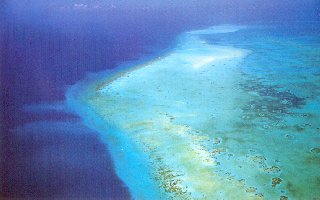
When we snorkeled we saw many different kinds of fish. At the Spanish Bay, schools of fish were swarming in every direction one would look. Birds have a bonanza with the abundance of sea life. I dont know the names of the different kinds of birds, but I know there were many. The sea has an abundance of grass on which the manatees thrive. There were also a few and very small islands. They are uninhabited because of their tiny sizes. Their very white "soil" look sandy , but it is not sand. One would think of it as ground up shells because of the abundance coral and having small chip shape, but it is not shells. Caryn told us that the white chips are dead algae. It is called calcareous algae, or calcium carbonate.
We saw few boats on the water, fewer than I expected to see for a country on the sea. There were a few fishing and tourists boats. There were also a couple of big ships carrying raw sugar to England to have it purified. The sugar we ate was raw; it looked like dirty wet regular sugar and with the usual sweet taste. Since the sea is shallow, ships stayed away from the shore and tug boats pulled the sugar barges to the ships. The temperature is almost constant throughout the year, the sea water is relatively warm, about 80 F.
The Weather:
At a latitude of 17 degrees, Belize is mostly sunny and warm year around.
Daytime temperatures are upper 80’s and at night it is about 60 F. It is
not humid even though Belize is near water. There is wind most of the time
coming from the Gulf of Mexico, eastern direction, and our measurements
showed that its velocity is around ten in the daytime. At nights it blows
very hard such that we had to close almost all the glass louvered windows
to the desired wind whistle, or tune. The wind coming from the opened window(s)
would turn the fans in the cabanas and sometimes very fast. The whistling
sound keeps one awake, but we got used to it.
The Wind is strong at night (by
Bob)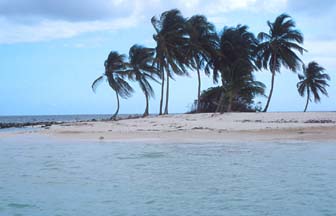
One night, the wind shifted direction and came from the land side on the west. The wind first stopped and the howling completely ceased to the point that most of us woke up because of the silence. There were no waves hitting the piers under the cabanas. Many people talked about that the next morning at breakfast. When the wind stops, sand flies come out and they can go through the window screen mesh. One cannot see them because they are small but they have a stinging bite. We had to close the windows tightly and it became to warm to sleep. For that reason we welcome the howling of the wind. One evening there was strong wind at dusk and the blowing sand stung our bare legs like sand fly bites.
Birds:
For bird watchers like Andy this place is just the ticket. Even I, who
think all birds look alike got to distinguish one from the other. On our
daily morning walk on the only path at the resort we see several different
species. The walkway is man made through the swamp by piling up the white
flakes of the dead algae ("sand") over a dirt base to a height of one foot.
It is very spongy soft under the foot like a thick carpet. Along the path
there is a long trunk of a dead tree, on top of which an osprey built its
nest. The nest must have been four feet in diameter. She sits on top of
it looking after the young which is as big as a chicken. 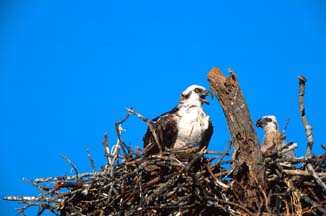 The mother was like a duck. When she saw us she would whistle loudly. One
day the male caught a fish with its claws like an airplane with a torpedo
on its bottom. The male carried its prey it to the nest for the mother
and the chick to eat. Next morning, we saw them still eating the catch.
That was our daily first morning ritual to see. Another special is the
afternoon show by three pelicans.
The mother was like a duck. When she saw us she would whistle loudly. One
day the male caught a fish with its claws like an airplane with a torpedo
on its bottom. The male carried its prey it to the nest for the mother
and the chick to eat. Next morning, we saw them still eating the catch.
That was our daily first morning ritual to see. Another special is the
afternoon show by three pelicans.
At the end of our day we would sit on the wooden deck (like a boat dock) behind each cabana. Most people did that to watch the three pelicans dive for their supper. They would fly close to the water until one sees a fish and then dive swiftly, ungracefully and noisily to catch it. The first time I saw this maneuver I thought the pelican fell in the water. The three birds did the daily show for us as if they knew many of us were watching the show and we were. We were also able to identify the individual pelicans.
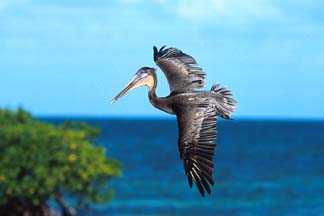 Pelican
diving for supper (by Bob)
Pelican
diving for supper (by Bob)
Mangroves:
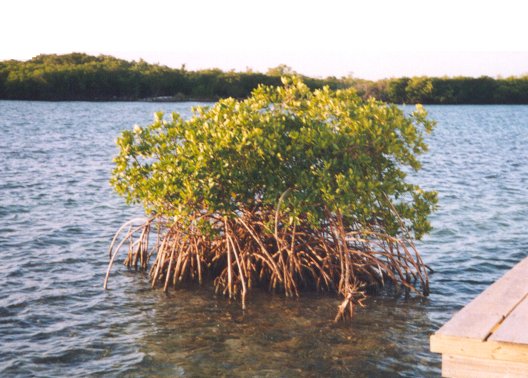
The red mangrove tree or bush is most unusual and fascinating. It lives in salt water, with roots like clutching fingers. It drops shoots from its limbs down to water and it plants itself to become another root. The seed is the shape of a seven inch pencil and stays on the tree for a whole year. In that time the tree supplies the seed with nutrients and it develops a needle shaped end. The seed is heavy on one side where the nutrients are stored. When the seed falls off, it position itself upright because of its one sided heavy weight, with the needle downward. When the needle hits the bottom of the water it forms a new root and the life of a new mangrove begins. This tree is called red mangrove because the roots look reddish specially in the afternoon when the sun is low.
The thick root system of the many trees form like a filter that traps
sediment from the sea water. In time the collected sediment begins to form
land. At that time the black mangrove comes in to start a new life. The
two mangroves differ in the shape of the leaves. The red is low and has
no distinct trunk, while the black is a tall tree and has a rough trunk.
Moreover the leaves of the black variety is salty. After that development,
the white mangrove comes in to establish life. A mangrove therefore is
red on the outside, enclosing the back which in turn encloses the white.
These multitudes of mangroves protect the main land from severe surges
of water currents.
Mangrove Tree (Looking from our cabana's back open porch)
Elda’s Garden:
Elda is the manager of the resort. She is knowledgeable of the resort and the country. She has a small garden of tomatoes, cilantro, mint, chives and other herbs. The small areas of soil are premium, and therefore she is careful of every square foot of the land. The produce she harvests is used in her cooking. She has two old bath tubs which she filled with dirt and became her chives and mint beds. Also, since water is purified on the premises, it is also used sparingly with no waste.
Belize City:
One afternoon, four of us (Helena, Marge, Beverly and I) arranged with Elda to have an open boat and a driver, Gilroy, to take us to the city to visit. We also took the two girls, her married daughter Xamara and the niece Rochell as guides and to give them a break. The sea was a little rough, but in 30 minutes we were in the city’s canal. We visited the national cultural center which is very small, a museum and best of all an art studio displaying local art. One show they were preparing for show is children art. They got children drawings from schools, and the artists reproduce them without alteration on large boards for display. In the craft center the most striking pieces were chairs and other wood pieces made of local wood of three color.
Elda’s daughter, Xamara, had her three children in Belize City looked after a nanny while the mother worked at the resort. We met them after school. The nanny was light hearted and yelled at Xamara, " where were you, we have been waiting for long time. Look at my arm, I got sun tan !" She was dark skinned.
On the last day, we walked around Belize city before going to the airport. The capital city is poor. If the foreign embassies and government buildings were taken out there will be nothing left except small wooden houses that need upkeep. It reminded me of my hometown of Qalqilya, except for its stone constructed houses. There is dirt on both side of the streets. While the city is poor, I did not see poverty. Stores are stocked up, and vegetables are plentiful. I did see one homeless. Most cars are old except of course the foreign brigade. The airport is no bigger than a small town port in the US, but it is clean and receives international flights. The view from the air shows a terrain with trees and shrubs that looked desolate, not cultivated. I understood that sugar cane, bananas and vegetables are grown abundantly in the south which we did not visit.
Before we traveled to Belize, many people warned us of crime in Belize City. We took precautions like carrying the money in pouches hung from the neck and under the outer shirt. We saw and encountered none whatsoever.
Remarks:
This is an usual trip in the sense that it was to a poor and small country. While the official language is English, the common language is Creol. The Belizean take pride and rightfully so in mixing the races through intermarriages. The main population is Mayan Indians but the immigrants are Spanish, Africans, Arabs, Chinese and others. The country was a British Colony known as the British Honduras.
Another unique aspect of the trip is the service we provided to the students. For a change, I worked for students by collecting data. Our contribution was manpower as well as monetary; the trip cost included actual contribution to the OSE and the students. One of them said that there is no work until a group comes in to the Spanish Bay; it is the only time they can operate because of the fund and the labor visitors provide.
It was sad to see the raw sugar being shipped to England to purify and some is returned for local consumption. Why was not purified in Belize where the people need work and foreign currency. It reminded me of the crude oil that was shipped to England from Iran before the 1950’s where it was refined and some was returned to Iran for local use. Also, the world famous English tea was not English grown. It was Indian tea, but was processed in England and then shipped to the world as English tea.
The people we met were the highlight of the trip. We worked, socialized,
ate, played, told jokes, and played cards nightly with them. I hope we
will meet some of them on another adventure.