9. The Ship:
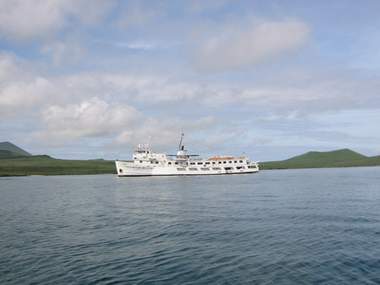
The Corinthian is an old ship designed for
48 passengers. The dining room and lounge are comfortable and nicely decorated.
It has three functional decks that are open to us. It is fairly quiet except
when the crew drops the anchor, which sounds like a tornado or worse especially
in the middle of the night when we set sail. Because it is small like most
others that are licensed to sail into the Galapagos rough waters, it rocks.
I thought this ship will make me seasick but it did not. The purser wakes
us up on the public address system in the morning at 7, and when the meals
are ready. He would say in a pleasant accent, “Ladies and Gentlemen, lunch
is ready, we are waiting for you in the dining room, bon appetit!”
|
|
|
|
|
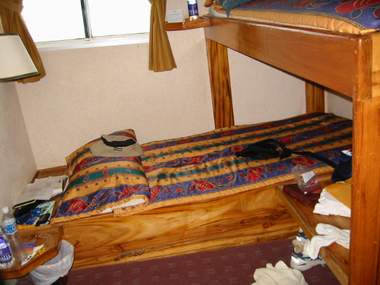
My cabin is designed for two but luckily I was by myself for I needed all the room. The bathroom was very adequate. The air conditioner was not cool enough to my liking. Moving about the room requires agility especially when changing clothes while the ship is moving. Hot water is not sufficient but I did not need any because it was warm there.
One day we saw a beautiful large ship anchored close to us. On its deck there were a helicopter, a large yacht and a sail boat. We asked the crew about it and we were told that the ship belonged to Bill Gates and it registered to enter the Galapagos waters.
10. Food:
The food that we ate was rich in fruits, vegetables and fish. Mangos and papayas were available at every meal. Oranges, bananas, pears, pineapples and peaches were present most of the time. We had plantain several times in different forms one of which was a soup. It was not very tasty. The beans in the salad were as large as grapes, and one kind of potato that was as small as peanut in a shell. Both of these were tasty. One kind of pancakes I liked was made of corn flour. Everywhere we went, we were reminded to drink only bottled water. Two bottles were placed daily in our cabins.
11. The Adventure:
Quito:
The trip started with a flight to Quito in
Ecuador. We were met in Miami by a representative of Elderhostel (from
Holbrook, the program coordinator) to expedite our travel as we were also
in the capital of Quito. The next morning we had an interesting lecture
about Ecuador, a word derived from the Equator, which passes through the
country. The capital elevation is 9400 feet. The oil producing country
has a population of 14 million people of who 95% are Catholics. I was disappointed
when I heard the country has $17 billion of debt. We took a long walk through
the city to feel the life and sounds of the country, even though it was
on Sunday. Besides oil, the country’s main products are coca, shrimp, and
roses of perfect shape. The currency is the actual US dollar that we use,
but the coins are different even though they are of equal denominations.
 |
 |
|
|
|
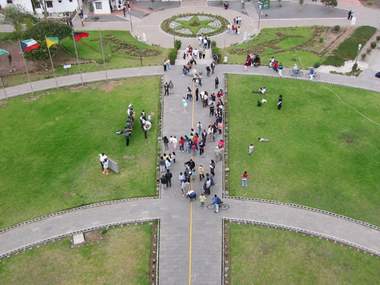
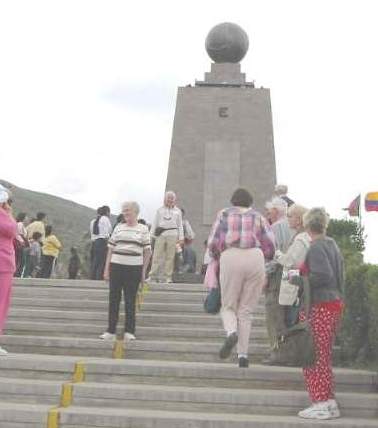
We visited the Equator Park. It was full of Sunday crowds with music, songs and different foods. A yellow line was drawn on the ground to specify the Equator dividing the two hemispheres. We climbed the monument, called La Mitad del Mundo (station of the World) with 0° 0’ 0” showing one side. We had lunch at a restaurant where we were given certificates that we ate at the Equator. When we crossed the Equator in our travel to different islands, the water vortex in the sink changed directions.
The Islands:
We flew next morning from Quito to San Cristobel, one of the islands of the Galapagos. It was hot and very humid, unlike Quito. The crew from our ship, the Corinthian, met us and by bus, took us to the ship. Our Elderhostel group of 19 joined another 20 visitors of various ages who had come on their own. We were divided into four groups for logistics, each given a name, Albatross, Boobies, Cormorants and Dolphins. Each group had a guide. I was with the Cormorants and our leader was Orlando. He was knowledgeable of birds, animals and geology. He was not a smiling man, but I got along well with him and I had the feeling that he too cared for me. Others had problems.
The program essentially has the same daily
format. We were woken up at 7, and after 7:30 breakfast, we go ashore on
dinghies, which they call pangas. The announcement on the loudspeakers
specifies the 8:30 AM disembarkation by groups, which they alternate every
time. We either had a wet or a dry landing, that is we land at the water’s
edge on the beach, or dry landing when we stepped out on rocks. Either
way, it took agility to disembark. We would then go on a field trip with
our guide to visit the terrain, see animals, birds and plants. We went
back to beach for swimming and snorkeling until we returned to the ship
by group, leaving our beach towels on deck, washing the sand off our feet
and shoes, and checking our names off to indicate one’s return. The ship
does not depart until all names have been checked. Lunch is announced like
in the case of all meals. We rest until 3:30, when announcement is made
for next phase of the day by disembarkation again. We would go for another
field trip and swimming, when we return to the Corinthian. At 6PM, we gather
on our own on the upper deck for a happy hour telling stories and other
lies, until dinnertime at 7:30. A lecture about some aspect of the archipelago
was given by one of our four guides and the schedule for the next day is
detailed.
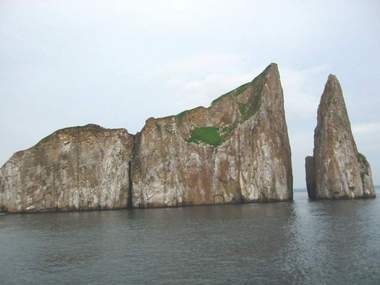 |
Kicker Rock |
After our first lunch, the ship sailed for about an hour. We passed by and went around a huge rock known as the Kicker Rock. It is a remnant of a vertical cone formation abruptly rising about 500 feet from the sea. Erosion caused it to split which to some people looks like a shoe. To me it looked like a very high wall standing in the middle of the ocean. We later disembarked on a nice sandy beach where there were numerous sea lions lying as if to welcome us. They looked and ignored us for the most part. Some participants swam and I snorkeled close to the beach. Waves were strong.
At night we sailed north to Genovesa Island, named for Genoa which is Colombus’s home town. The English named it Tower Island. While sailing, we crossed from the southern to the northern hemisphere. Genovesa is a haven for birds, all over the island. There were red footed, and hooded or Nazca boobies, frigates, and swallow-tailed gulls among others. These birds did not fly away when we got close to them even when we were within arm’s length. There are no scavengers on the islands. When an animal dies, its body lays on the ground until it decays to nothing.
Animals are classified into three different classes. Endemic meaning that a species exists only on the Galapagos and in no other place in the world. When a certain animal exists on these islands as well as in other places, it is classified as indigenous. The third class is called introduced, which is an animal that was brought into the archipelago by man such as the goat, donkey, rat, cow and several others. The introduced animals have done the most damage to the Galapagos.
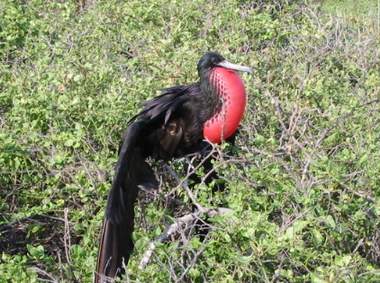
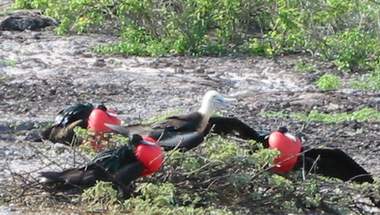
Frigate Bird:
It is a large black bird with long wingspan,
and forked tail for maneuverability in mid air. They chase other birds
coming back from a sea hunt. The frigate pulls the tail of the other bird
until it disgorges the food from its stomach. The frigate then takes it
away. It acts like a pirate, and the name frigate is that of a pirate’s
ship. The male has a very large bright red pouch under its bill, which
it inflates to attract females. There are usually several males sitting
around one female from which she chooses a partner. It has short legs and
small feet, and therefore it needs open terrain to use as a runway in order
to fly.
 |
 |
|
|
|
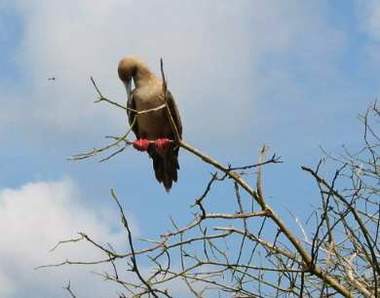
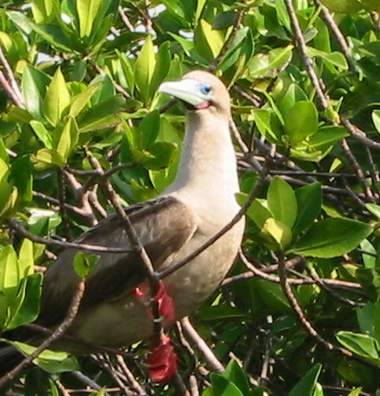
Red footed boobies:
This bird has red webbed feet with claws
to enable it to perch on trees where it can be seen unlike other boobies.
It builds a crude nest of twigs where it lays one egg. It has short legs
and cannot take off from the ground.
 |
 |
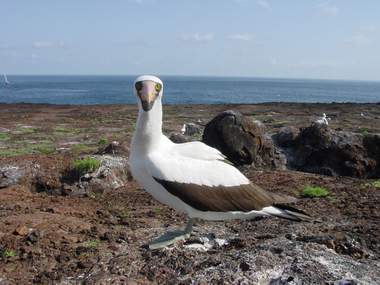
Nazca or Hooded Booby:
The large white bird has gray webbed feet.
It lives on high rocks in open areas by the sea. It nests on the ground.
The hen lays two eggs and the male helps incubate them, but only one offspring
is nurtured to maturity. All boobies have sharp eyesight. They dive for
fish from an altitude of 50 feet with beak closed, then turn upward toward
the prey.
 |
 |
|
|
|
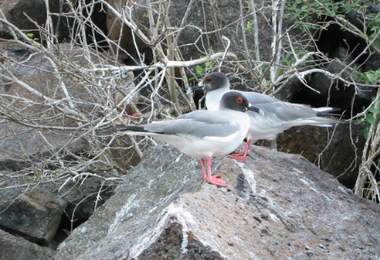
Swallow-Tailed Gull:
This gull is endemic to the Galapagos. It is a monogamous bird for life, and is very loving to its partner. The pair caresses each other affectionately. The gull developed an adaptive behavior of hunting at night as it has good vision. Fish and squid tend to swim near the water surface at night.
Our next landing was the largest island of Isabela, which is in the southern hemisphere. In the 1950’s uplift occurred by the shoreline and it is visible. The circular shape did not rise as much as the terrain there. The vegetation in these winter months is healthy covering the whole uplifted ground. There were land iguanas, which are large, brown and approachable. They would look at us and we at them and they ignored us. The sand of the beach is very coarse and volcanic black in color. Most visitors swam and snorkeled there but I did not because the waves were very strong and I would not have enjoyed the activity. There were a few sea lions lying on the beach. People and lions had mutual ignoring. One young German visitor who is a physician laid down on the sand very close to photograph a sea lion, almost nose to nose.
From there we sailed about an hour to Fernandia. This is the youngest island in the archipelago. It is about half a million years old. Its volcano is still active with the last eruption taking place in 1995. It has no introduced animals. They are all original, endemic and indigenous. We saw hundreds of marine iguanas of all sizes. Crabs and of course sea lions were plentiful.
We rode around in the pangas and watched the flightless bird, the cormorant. It is a graceful bird with small wings because it does not fly. There was also the Galapagos penguin which is a small bird.
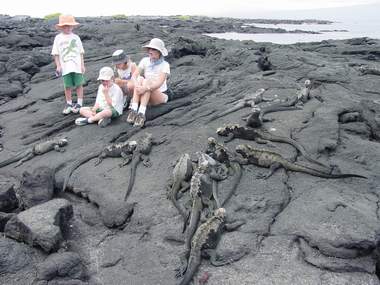
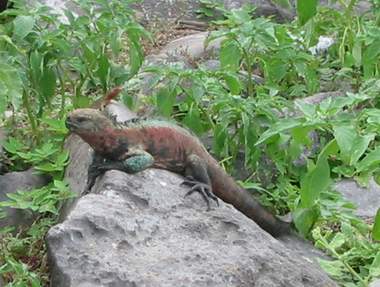
Marine Iguana:
The marine iguana is the only sea lizard in the world and it is endemic to the Galapagos Islands. The iguana is vegetarian, and swims as far as 50 feet below the surface of the water for about half an hour in search of algae and seaweed. It is about five feet in length, they gather in large groups on the rocky island beaches to bask in the sun. The young is charcoal in color, but adult males are dark. On EspaÔola Island the iguana has bright patches of red and green and is often called the Christmas iguana.
Marine iguanas drink seawater and filter
out the salt. They spit the salt in a sharp spray to a distance of four
feet or more. If one stands in front of it, one will be on the receiving
end of the spit. When they gather basking in the sun, the only thing they
do is spitting.
 |
 |
|
|
|
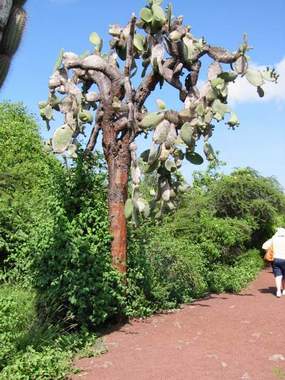
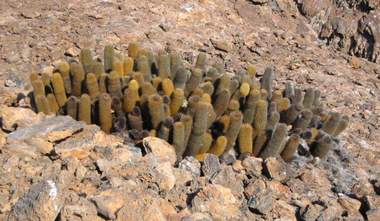
Land Iguana:
This large lazy iguana can only be found
on the Galapagos Islands. The rough, wrinkled skin is yellow, rust and
brown patches, and about 4 feet long. Land iguanas are territorial animals;
males are aggressive toward one another, but not to humans. Their natural
predators include hawks and owls, which eat the young. Land iguanas can
live for more than 60 years. The iguana is vegetarian and likes cactus
fruit and the leaves including thorns. The cactus provides the iguanas
food and water.
 |
 |
|
|
|
Flightless Cormorant:
The cormorant
is an endemic bird inhabiting the coasts of the Galapagos Islands, which
are rich in food due to upwelling, and has no predators. The cormorant
had therefore no need to fly and by gradual adaptive radiation lost its
functional wings. Its length is about three feet. Their mating dance takes
place in the water while swimming. Unfortunately I did not see the ritual.
After the eggs are hatched, the female leaves the male and takes off to
find her another mate. Fickle females!!
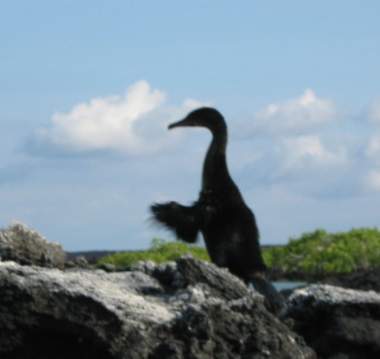 |
Flightless (Small Wings) Cormorant |
At night we sailed to the next destination
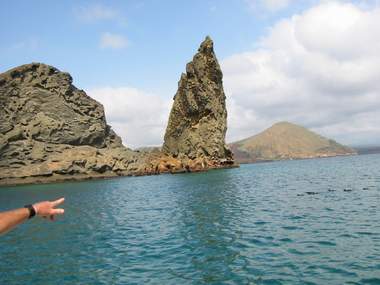
of Bartolome Island close to Santiago Island. It is volcanic and young
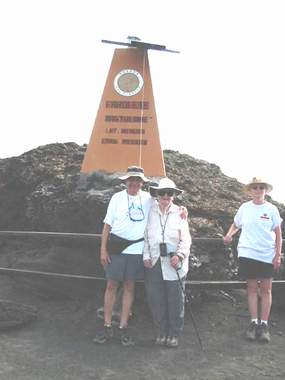
with little vegetation. We climbed a mountain to see the view form the
top and there was a solar powered lighthouse. The last part of the climb
were well constructed 370 steps. Every where we went, we could walk only
on marked trails, no exception. Dorothy Harless from Montana climbed with
us as she did everything including swimming and snorkeling. That day was
her 81st birthday. When we reached the top we all sang happy birthday to
her. She was surprised that we knew. But her daughter Ella was with her
and she was the one who told a few of us. On the way down, we met another
group from the Corinthian who too stopped and sang the same song to her.
 |
 |
|
|
|
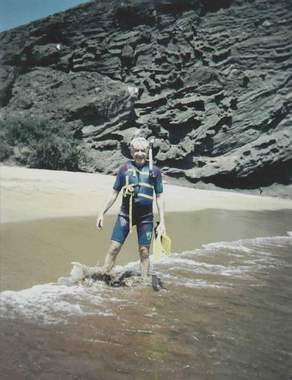
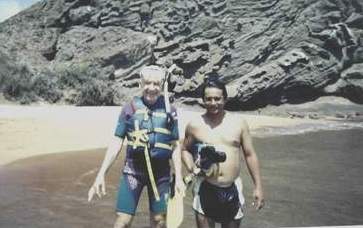
We came back to the beach to swim and snorkel.
One of the guides, Alexis told me to wear a life vest and to snorkel with
him. The jacket was great, and he was superb. He stayed close to me sometimes
with his hand on my jacket because I often lost my direction. The current
was strong and sometimes I could not overcome it. We snorkeled with the
better swimmers whom we called Rambo Snorkelers. We swam to the Pinnacle
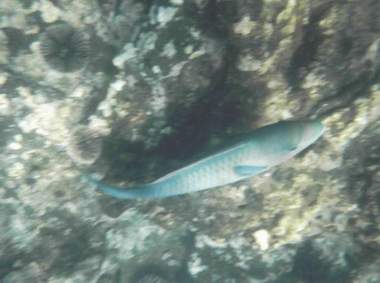
Island where the water was deep, and the scene below, gorgeous. The sea
floor was rugged volcanic rock formation. I took some pictures of the fish
there. I was so happy about the experience because I could not have done
it by myself. I repeated the experience at two other locations and every
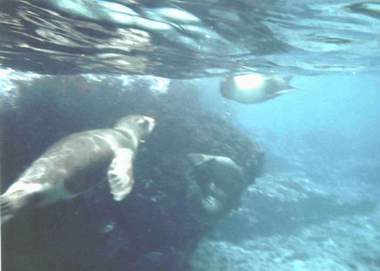
time I would go with the Rambos. One time, there were three sea lions very
close to me and I photographed them. Alexis told the group of Rambos that
if we were lucky we would see sharks and assured us they were not harmful,
if they came close.
 |
 |
|
|
|
 |
 |
|
|
|
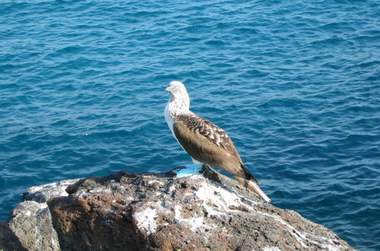
On the same day we sailed a short distance to Seymore Island. It is populated with the blue footed boobies. I have not figured out why they have blue feet, or red feet. Sea lions are plentiful here too as they were on all islands. Although the terrain is rough due to volcanic lava deposits, the lions often crawl on these rocks for about a mile inland. We saw sea lion babies waiting for the mothers to feed them. They stay put until the mother comes back. We saw one baby who seemed to be thin and starving. Its mother either lost it or was killed by sharks. Our intuition was to move it close to sea but it is futile because sea lions do not adopt.
Blue footed Booby:
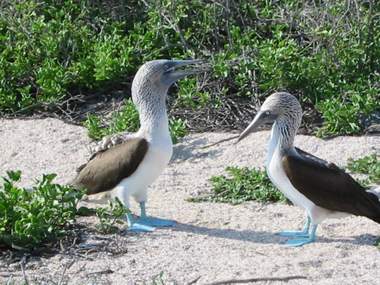
It is most famous of all Galapagos’s birds.
Their mating dance is unusual. The female raises one foot slowly up and
down tilting her head in the other direction. Then she does the same with
the other foot in front and close to the male. The bird unlike other boobies,
is solitary and lays its eggs right on the ground When hatched only one
chick is cared for by the parents. It feeds on fish like the red and hooded
boobies, as they are all excellent divers.
 |
 |
The name booby means in Spanish, clown. It was named by sailors who thought the bird looked funny. They perched on the British ships hatches near the bow from which came the uncomplimentary name “booby hatch”. Also in American slang, “he is a boob,” meaning a clown.
It was a short sailing distance to the next island of Santa Cruz where we were still in the southern hemisphere. The night travel was rough and the ship rocked and rolled. We docked for the first time on the morning of Friday April 5 in a town named Puerto Ayorto. We were isolated from the world for several days and did not know current events. We had no newspapers, radio, television or Internet. In this town half of the passengers departed the Corinthian as scheduled. There were emotional farewells because we got used to each other. We picked up seven new passengers from three families. We too got along right away. We visited Darwin Research Station. It is very large and has a large staff of researchers.
The tortoise population had been decimated a long time ago. The station is working successfully to repopulate the islands. There were 14 species there, three of them are extinct. The staff collects tortoise eggs by species and by island. The eggs are incubated at the Station and the hatchlings are reared until the age of 10 years when they are large enough to avoid their predator, the hawk. Then they are released in the wild. Success rate is high.
There is one of the saddle back varieties, named Lonesome George. He is very big, at 80 years old weighing more than 200 pounds. George has no mate although the station has added two females of different species for company with no success. George is still lonesome. The search has gone on for some time to see which zoo in the world has a female of the same species as George’s. If none is found, George will be the end of the line.
In Espanola Island, the researchers found 12 females on one side of the island, and two males on the opposite side. They took all to the Darwin Station to breed them. The experiment failed. One male was located in the San Diego zoo that came from Espanola. He, named Diego, was brought to the station for breeding. Diego mated with all 12 of the females. The two males learned from the master and started to mate with the females too. The station has now put 1250 of this species in the Espanola Island.
On Santa Cruz there were two huge craters
on the top of the mountain where the rainfall is 50 inches. On the lowland
it is 10 inches. The terrain is not very rugged, and the land is fertile
with lush vegetation. The inhabitants own domesticated animals, fruit trees
and crops. We visited a large lava tube there and walked inside it.
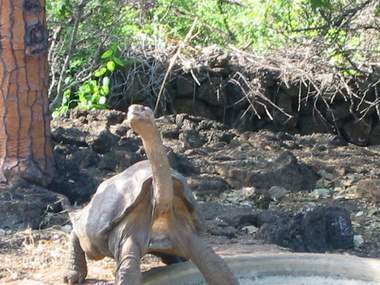 |
The 81 Year Old George |
Giant Tortoise:
The giant tortoise, for which the Galapagos Islands are named, is one of the world's largest tortoises, weighing up to 500 pounds, and can live to 150 years. The shells of the various species of the tortoise have evolved into shapes depending on where they lived and what they ate. The saddle back tortoise lives in drier location feeding on tree leaves and therefore developed long necks. The highland tortoises have larger, dome-shaped shells and live in lush vegetation and feed on grass, plants and fallen fruit. The tortoise can metabolize fat to produce water and therefore can survive long periods without drinking any water. This is what made them popular with the pirates who hunted them for meat by keeping them alive. They lay eggs in holes covered by dirt. The sex of the hatchlings is determined by the temperature at which they are kept. The hotter eggs produce females.
During the night hours we sailed to Espanola. The sea was very rough. It was the roughest travel we encountered. My water bottle and other things in my cabin tumbled. I woke up at 2 AM and heard the waves whooshing. My port drape was swinging quite a bit. I was moving in bed side to side in synchrony with the ship. After breakfast we boarded the pangas from the ship to the shore of white sand. There were many sea lions, maybe a 100 of all sizes. Some would go into the water to play, others just lay there in the sun. They are brown when dry, and black when wet. One big bull saw another bull that he obviously did not like and charged him. They fought with their necks. The loser then dashed into the water and the other chased him. I did not think they could move that fast. They darted towards the swimmers and one woman was startled and screamed, but they did not harm her as the two bulls veered off to avoid her. Sea lions are very playful except when one bull senses competition from a human or another bull.
There were many sea crabs, marine iguanas and sea turtles, which are not as large as the giant tortoise. Sea turtles go on elevated sand dune, make a bowl shaped nest of about 3 foot diameter, to lay eggs. They dig a hole in the sand and deposit the eggs, then leave.
I went with the Rambos on a panga to snorkel near a cluster of huge volcanic and jagged rocks in the middle of the water. Again with the help of Alexis and a life jacket I was able to do it. I saw a sting ray laying at the sea floor, schools of colorful fish, and sea lions. The sea is full of life. I was very happy about this experience.
In the afternoon, we went for a rough hike, walking most of the time on rocks. We wanted to see the albatross. We saw only three in mid air because their season to be on this island had not arrived. There was a blowhole where the water would shoot up high when the waves slam into the rocky shore. It reminded me of the Old Faithful except this one is not regular timed. The hike was otherwise not comfortable because the mosquitoes were very abundant, but the repellant spray saved the day.
The last island to visit was Floreana. It
is beautiful with lush vegetation. It has many introduced animals, goats,
cows, and others. We visited the Post Office Bay where once the barrel
was placed. Now it is like a pigeon cage. In a zip locked plastic bag were
many letters left there by tourists to different parts of the world, from
Australia to Switzerland. Many cards were addressed to the US.
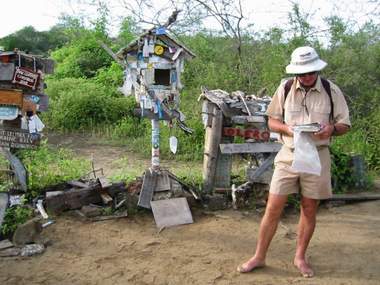 |
The Post Office Barrel, Now a Pigon Hole. Our Leader is Reading Letter Destinations. |
If a visitor is from the same locality as the address, he or she may take the card or letter and hand deliver it to the addressee. The island was first inhabited by a Norwegian group who later abandoned their hamlet and returned home. See the Appendix for a detailed story about settlers on the island.
We flew back to Quito next day from San Cristobal Island. We had an overnight stay in Quito where the weather was mild and the air chilly. It was a welcome change for us after we had endured the high humidity for eight days. From the capital, we flew back to the US.
12. Conclusion:
The Galapagos trip was very interesting and unusual. The 81-year-old Dorothy was an inspiring woman. She went everywhere with the group. She did not mince. If one keeps up good outlook, spirit, and physical activity, one is likely to live a rewarding life.
A few days after my return home. I received an email from Dorothy’s daughter, Ella informing me that her mother had suffered a heart attack. Her physician had put a stint in the artery. I sent my best wishes to Dorothy. The next day she emailed me that she is home and doing very well. That’s Dorothy.
The unusual part of this experience is the fact that animals live in harmony with one another. Humans do not intimidate them. One can almost reach for the animal. The size of the tortoises and iguanas are remarkably huge.
Snorkeling was exciting. Like all in activities I am always intimidated before I start, even skiing which I have done for years. Once I jump in, I feel more comfortable. I remember when I did rappelling for the first time, my face was ashen as the photograph showed. Snorkeling was very frightening but I did it a few times and would it again, even in rough waters as long as I have on a good life vest.
I have seen Mexico, Belize and Ecuador in
Latin America. One common characteristic they share is low standard of
living. There is a significant difference between the US and the other
countries south of the border. The US is making a big mistake in not helping
these countries develop to a higher plane. If they do, the whole Western
Hemisphere could become a gigantic economic market. Mexico and Ecuador
are oil producing countries and they should have much higher standard of
living than the present.