Page3
After spending four full and busy days on the Pantanal, we went back to the Campo Grande airport and flew to Sao Paulo. From there we went to the city of Foz do Iguazu to see the Iguazu Falls in the southern part of Brazil. This is the area where Brazil, Argentina, and Paraguay meet. There was a part of Iguazu city in each of the three countries as the falls are located in the Iguazu National Park (one in Brazil and another with the same name in Argentina) supported in part by UNESCO.
Iguazu, is pronounced e-wa-zoo. The “I” was “Y” meaning water, guazu stands for big, and the “G” is hardly pronounced. It is Big Water in local Indian language. We arrived at midnight and met our beautiful guide, Delma, who escorted us to a very nice stately hotel called Hotel Tropical das Cataratas located in the park overlooking the Brazilian side of the falls. Delma worked for the Argentinean park service as an ecologist. When we got to our rooms, many of us did not know how to turn on the lights. We were talking to each other about it in the hallway. One had to put the key card in a special pad inside the room to be able to turn on power. When one left the room, the card is pulled out, and all lights and air conditioner would turn off in a couple of minutes for energy conservation.
 |
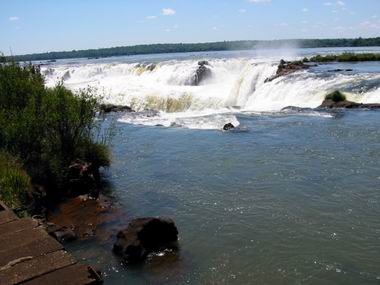 |
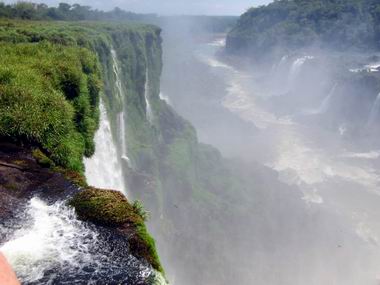
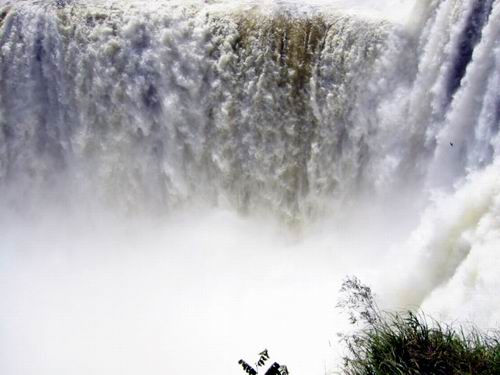
After a good buffet breakfast at the hotel, we saw the beauty of the falls from the hotel. The river basin was formed by the confluence of the Parana River and Iguazu River. The basin spreads to a mile wide and forms 275 individual falls, which are 200 feet high. The falls were as impressive as Niagara Falls, and much wider.I It seemed like the water was endless. There were falls in any direction one looked. We went first to the Argentinean side to see the falls from that vantage point. Most of the falls are located in Argentina but the view is best from Brazil. Argentina has constructed a clever system of walkways to accommodate visitors. The workmanship of the long walkways was excellent. They also built a small railway to transport viewers to the head of each of the three trails. Each trail led to various parts of the falls. The trails are long, but comfortable to walk on, and afford a visitor good viewing perspective. There were hordes of tourists, most of whom were from South America, and others who were from Europe. The falls, especially the Devil’s Throat (See top of Page 1) were awesome in theirs magnitude, roar, and mist.
The railway cars had comfortable wooden benches, every two facing each other. Each bench accommodated four passengers, provided they sit close to one another, facing four others and knees almost touching. On one stretch, a passenger from Chile had a water bottle. He unscrewed the cover and passed the bottle around offering drinks to the rest of us. Three took sips right off the spout. I thought it was a nice and friendly gesture. They were traveling together.
A 45-member crew was setting up camera equipment to film a stunt for Fear Factor, a reality television show. For the stunt, they strung cables across one of the high falls, and the contestants were to walk on the cable. There was of course a safety cable. We all waited to see the stunt, which we were told would start shortly. It did not happen, so by three o’clock we were hungry and left. It was interesting that all members of the crew were young, athletic, nice looking and were wearing black uniforms.
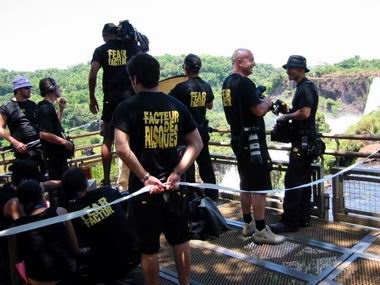 Fear Factor Crew Fear Factor Crew |
We spent one day in Argentina and the next day in Brazil. The Brazilian side was harder to reach because of the many steps visitors had to take going down. The Iguazu Falls were as impressive as the other side. The mist was heavy and it was hard to use cameras. Going down we saw a tiny coati, which must have been left by its mother or been lost. It was possible to ride a boat to view the falls from below, but none of us did, and it was not on the itinerary. We had lunch at local buffet style restaurant. The food and the service were very good.
|
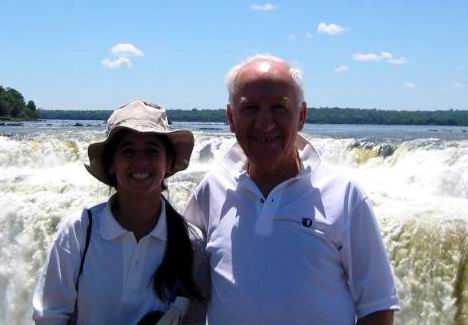
With Guide Delma
 |
Food
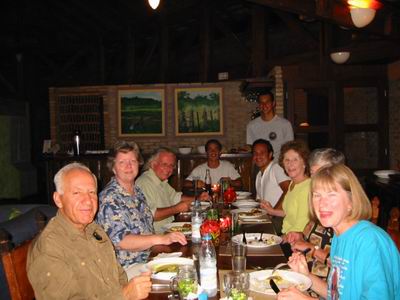
Food was generally very good, well cooked and lightly spiced. I was surprised that it did not have a Mexican flavor. Later, I was told that the food was influenced by cuisine of the colonial power, Portugal. The diet relied heavily on beef, because of its abundance. Rice and red beans were served separately, not in one mixture, and were served at almost every meal. Chicken and fish were the next protein source. Of the common vegetables, the pumpkin and eggplant were dominant. Pumpkins or bananas were sometimes sautéed with beef cubes and onions. Stewed pumpkins and bananas were also served and were tasty. Fruits included most tropical types like papaya and pineapple. Mango was abundant, but not in season. Their roast beef was the same, tough and tasty, as in other places. Several desserts, especially the caramel (which was the favorite of Pat Sellers), were always served in restaurants, but I do not know if the same is true in family homes. I had a good impression of the Brazilian food and ate all varieties.
 |
Economy
We unfortunately did not form a thorough opinion of the economy of the country, because we were not in the cities but in Pantanal, the swamp. Cattle is a very big industry; we saw large herds everywhere we traveled. People and towns, unlike what I observed in other Latin countries, seem to be well off. The main unit of the currency is the real, pronounced “he-yal” for singular and “he-yes” for the plural. One US dollar is about 3 reals. Prices of most items are low or very low with respect to other countries. A beer in a restaurant, for example, is a dollar. I did not find out the wages of workers.
Conclusion
The Pantanal is an expansive theater playing the story of the cycle of life. With the annual rain, rivers, lagoons, and ponds fill with floodwater and life begins. Trees, weeds, animals, birds, fish, reptiles, and insects all come alive, healthy and thriving. One species lives off the other, dead or alive. With the dry season onslaught, the water recedes and life begins to wither slowly. At the end, only rivers and deep lagoons hold any water. Species that were able to reach those wet areas survive to the next season of rain. The Iguazu Falls are a sight to see. Their sheer size is breath taking.
We were well cared for throughout the expedition. At all airports, representatives met us and shepherded us into the right paths. Our guides, Bruno and Delma were professional people and were well-versed in their domains of expertise. I just wished we had in addition speakers on the various aspects of Brazil, such as the economy, culture, politics and the dynamics of the western hemisphere.
I was disappointed that I could not take pictures of birds and animals because I did not have a telephoto lens on my camera. However, my companions sent me some close-ups, as indicated. One person we met from the California group, David Richardson, had stunning pictures. He had a professional digital camera. His website is oakport.com . I hope to view his pictures when he posts them. The trip was very good, and the time well spent.
I have noticed that in the southern hemisphere, water whirls in the clockwise direction. Here at home in the northern hemisphere, it is counterclockwise.
 |